How to tell if your AC needs refrigerant or a repair
Your AC is blowing warm air and you're not sure if it needs refrigerant or a repair. Here's how to tell the difference before you call anyone in Des Moines.
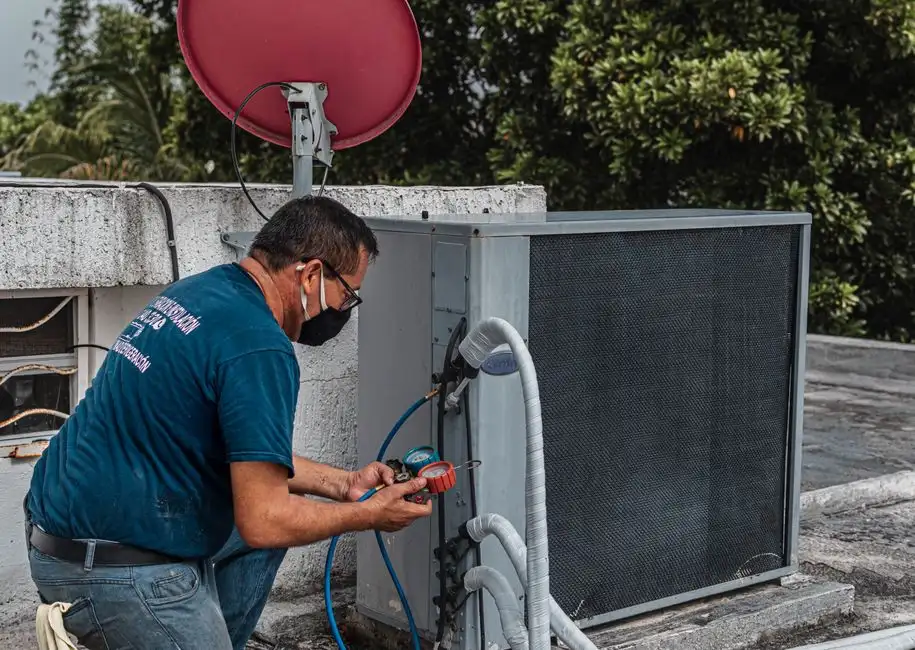
If your AC is blowing warm air, the fastest way to tell whether it needs refrigerant or a repair is this: refrigerant is a closed system - it does not get used up like gas in a car. If your system is low on refrigerant, it has a leak, and that leak is the repair. Adding refrigerant without fixing the leak is a temporary patch that will fail again, usually within one cooling season. The sections below walk you through the specific symptoms we see across Des Moines, what a recharge actually costs in 2026, and how to know when it's time to call us.
Knowing how to tell if your AC needs refrigerant or a repair saves you money either way. A $180 diagnostic that finds a loose Schrader valve is a lot cheaper than a $1,400 compressor replacement caused by running a system low on charge for two summers.
The short answer: refrigerant or repair?
In Des Moines, an air conditioner that is low on refrigerant always has a repair waiting behind it. Refrigerant is not a consumable - a sealed system holds the exact factory charge for its entire life. When we hook up gauges and find pressures 15 to 20 percent below the nameplate charge, we are not looking at a maintenance issue. We are looking at a leak somewhere in the copper lines, the evaporator coil, the condenser coil, or the service valves.
That distinction matters because the two problems have completely different fixes. A refrigerant recharge tops off the charge and buys you time. A leak repair finds the hole, seals it, pressure-tests the system, and then recharges to the correct weight. Only one of those solves the problem.
If your system is more than 12 years old and the leak is in the evaporator coil, the honest answer is often that replacement makes more financial sense than repair. We walk through that math with every customer before we pick up a wrench.
How your AC actually uses refrigerant
Your air conditioner moves heat, not air, and refrigerant is the fluid that carries that heat from inside your house to the outdoor unit. The system is sealed - copper lines connect the indoor evaporator coil to the outdoor condenser, and the refrigerant cycles between liquid and gas states hundreds of times per cooling season without ever being consumed.
That is why a properly functioning AC never needs a top-off. If a technician tells you that your system "just needs a little refrigerant every year," that is a leak they have not found yet. A sealed system loses less than 1 ounce per year under normal conditions, and most lose nothing at all.
When the charge drops, three things happen at once. The evaporator coil runs too cold and starts to ice over. The compressor works harder and draws higher amps. And the air coming out of your vents gets warmer instead of colder. By the time you notice the warm air, the system has usually been running low for weeks.
Signs of low refrigerant in air conditioner Des Moines IA
Low refrigerant symptoms in Des Moines look different depending on the humidity and how hard the system is working. In our July and August stretches - when we string together 10 or more days above 90°F - a system that is 10 percent low on charge will struggle to hold 75°F indoors. In a milder June, that same system might keep up fine and you would never know anything was wrong.
Here are the symptoms we see most often, roughly in the order they show up:
- Warm air from the vents. Supply air should run 15 to 20°F cooler than return air. If your vents are blowing 70°F when the house is 78°F, the charge is suspect.
- Ice on the indoor coil or the copper line. A frozen evaporator coil is the single most common sign of low refrigerant. Ice on the big copper line entering the indoor unit is the tell.
- Long run times. If your AC runs 45 minutes or more per cycle and still does not hit the thermostat setpoint, the system is losing capacity.
- Hissing or bubbling at the outdoor unit. That is refrigerant escaping through a leak, usually at a flare fitting or a brazed joint.
- Higher electric bills. A system low on charge can draw 10 to 15 percent more power for the same cooling output.
- Compressor short-cycling or tripping the breaker. This is the late-stage symptom, and it usually means damage has already started.
If you are seeing two or more of these, the next step is a set of gauges and a superheat/subcool reading. That is the only way to confirm a low charge versus a dirty coil, a failing blower, or a bad capacitor - all of which can mimic the same symptoms.
We run into this constantly in older neighborhoods. Homes around air conditioning repair Des Moines IA with original 1990s copper line sets are prone to pinhole leaks from formicary corrosion, especially where the lines run through humid crawlspaces.
Why does my AC keep losing refrigerant in Des Moines?
An AC that keeps losing refrigerant has an active leak that was never properly repaired. In our experience across Des Moines, the leak almost always falls into one of five categories:
- Evaporator coil leaks. The most common, and the most expensive to fix. Formic acid from household cleaners and off-gassing building materials attacks the copper and aluminum from the inside.
- Condenser coil leaks. Usually from lawn mower debris, hail damage, or vibration fatigue at the tube sheet.
- Line set leaks. Pinholes in the copper, often where the line passes through a wall or rubs against a joist.
- Flare and brazed joint leaks. Vibration works these loose over time. Common at the outdoor service valves.
- Schrader valve leaks. The small valve cores where gauges connect. Cheap part, easy fix, but easy to miss.
If a previous company added refrigerant without leak-searching, the leak is still there. That is why we always pressure-test with nitrogen and use an electronic leak detector before we add a single ounce of refrigerant. Finding the leak is the job. Adding refrigerant is just the last step.
AC recharge vs repair cost Des Moines: what to expect in 2026
Typical 2026 pricing in the Des Moines area breaks down roughly like this, and the gap between the two columns is the whole reason this decision matters:
- Diagnostic visit: $89 to $149. Includes gauges, superheat/subcool, and a written leak assessment.
- Refrigerant recharge only (R-410A): $75 to $150 per pound installed. A typical 3-ton system holds 8 to 12 pounds, so a full recharge runs $600 to $1,800 depending on how low it is.
- R-22 recharge (pre-2010 systems): $150 to $300 per pound. R-22 was phased out of production in 2020, so the only supply is reclaimed. This is often the point where replacement wins.
- Leak search and seal: $250 to $600, depending on how buried the leak is.
- Evaporator coil replacement: $1,200 to $2,400 installed.
- Line set replacement: $600 to $1,400.
- Full system replacement: $4,500 to $9,500 for a new condenser and coil, installed.
Here is the math that matters. If your system is 8 years old and the leak is at a flare fitting, a $400 repair plus a $300 recharge is a clear win. If your system is 15 years old and the evaporator coil is leaking, you are looking at $2,000 in repairs on a unit with maybe three summers left. In that case, putting that money toward a air conditioning installation Des Moines IA is the better call.
One thing we always tell customers: do not let anyone sell you a recharge without a leak search. It is the HVAC equivalent of putting air in a tire with a nail in it.
How much refrigerant does my AC need Des Moines Iowa?
The correct charge is stamped on the data plate of your outdoor unit, listed as ounces of refrigerant by weight. A typical 2-ton system holds about 6 to 8 pounds. A 3-ton holds 8 to 12 pounds. A 5-ton holds 14 to 18 pounds. Those numbers assume a line set of 15 to 25 feet - longer runs need additional charge, usually 0.6 ounces per foot of liquid line over 15 feet.
What matters more than the total is how much is missing. If your system is 2 pounds low, that is a small leak and a targeted repair. If it is 6 pounds low on a 10-pound charge, the leak is significant and the system has been running starved for a while. We measure the exact amount we add, in ounces, and write it on the invoice so you have a baseline for next season.
If you have a heat pump instead of a straight AC, the same rules apply - the refrigerant circuit is the same, and a low charge shows up as poor heating in winter and poor cooling in summer. We handle those under heat pump repair Des Moines IA and always check the reversing valve and defrost board at the same time.
Common mistakes homeowners make
The biggest mistake we see is treating a refrigerant problem as a maintenance item instead of a repair. Here is what to avoid:
- Adding refrigerant without finding the leak. It will leak out again, and you will pay twice.
- Using DIY recharge kits from the hardware store. Those cans contain sealant that can clog the metering device and the compressor. We have seen $3,000 compressors destroyed by a $40 can.
- Running the system with a frozen coil. Ice blocks airflow, the compressor overheats, and a $400 repair turns into a $2,000 one.
- Assuming a warm house means low refrigerant. Dirty filters, a failed capacitor, a stuck contactor, and a bad thermostat all cause the same symptom.
- Skipping annual service. A spring air conditioning maintenance Des Moines IA visit catches small leaks and low charge before they become summer emergencies.
One more: do not let anyone tell you that a system "just needs a recharge every year." That is not a thing. If it needs refrigerant, it has a leak.
When to call a professional
Call us when you see ice on the indoor coil, hear hissing at the outdoor unit, or notice your electric bill climbing while the house stays warm. Those are the three signs that point to a refrigerant issue rather than a simple airflow problem. We bring gauges, an electronic leak detector, and nitrogen for pressure testing on every diagnostic - no guesswork, no "let's try a recharge and see."
Des Moines Heating Repair Pros handles refrigerant diagnostics, leak repair, and full system replacement across the metro. We give you a flat diagnostic price up front, tell you what we find, and let you decide. If a recharge is the right call, we will say so. If replacement makes more sense, we will show you the numbers.
We also serve the older neighborhoods where this problem is most common. Homeowners dealing with an Heating Repair Des Moines IA issue in the winter often discover their AC has the same underlying leak problem when we open up the system in spring.
Frequently Asked Questions
How do I know if my AC needs refrigerant in Des Moines?
Ice on the indoor coil, warm air from the vents, and long run times are the top three signs. A set of gauges confirms it. If the charge is more than 10 percent below the nameplate, you have a leak that needs repair.
How much does AC refrigerant cost in Des Moines IA?
In 2026, R-410A runs $75 to $150 per pound installed. A typical 3-ton system needs 8 to 12 pounds, so a full recharge is $600 to $1,800. R-22 systems cost $150 to $300 per pound because the refrigerant is no longer produced.
Can I just add refrigerant to my AC in Des Moines Iowa?
You can, but it will leak out again. Refrigerant is not consumed - a low charge means a leak. Adding refrigerant without repairing the leak is a temporary fix that usually fails within one cooling season and can damage the compressor.
Why does my AC keep losing refrigerant in Des Moines?
An active leak that was never properly repaired. The most common sources are evaporator coil corrosion, line set pinholes, and loose flare fittings at the outdoor unit. A proper leak search with nitrogen and an electronic detector finds it.
How much refrigerant does my AC need in Des Moines Iowa?
The exact charge is on your outdoor unit's data plate, listed by weight. A 3-ton system holds 8 to 12 pounds. Line sets longer than 15 feet need additional charge, usually about 0.6 ounces per extra foot.
Get help with HVAC in Des Moines
If your AC is blowing warm and you are not sure whether it needs refrigerant or a repair, we will find out for you. One diagnostic visit, a clear answer, and a flat price before we start.
Call Des Moines Heating Repair Pros at 515-876-5435 to schedule your AC diagnostic today.